Road to Recovery: A Movement to Save our Shared Species
By: Esmeralda Bravo, R2R International Fellow
In recent decades, the birds we share across the continent have begun to disappear. This is not a metaphor—it’s a painful reality. In 2019, a Science publication documented the loss of three billion birds in the United States and Canada.
In response, Road to Recovery (R2R) was born—an initiative that brings together scientists, managers, communicators, and communities to launch a collective movement focused on the recovery of Tipping Point Species. Our work focuses on something very concrete: supporting species-specific working groups dedicated to understanding, addressing, and reversing the decline of bird species at risk.
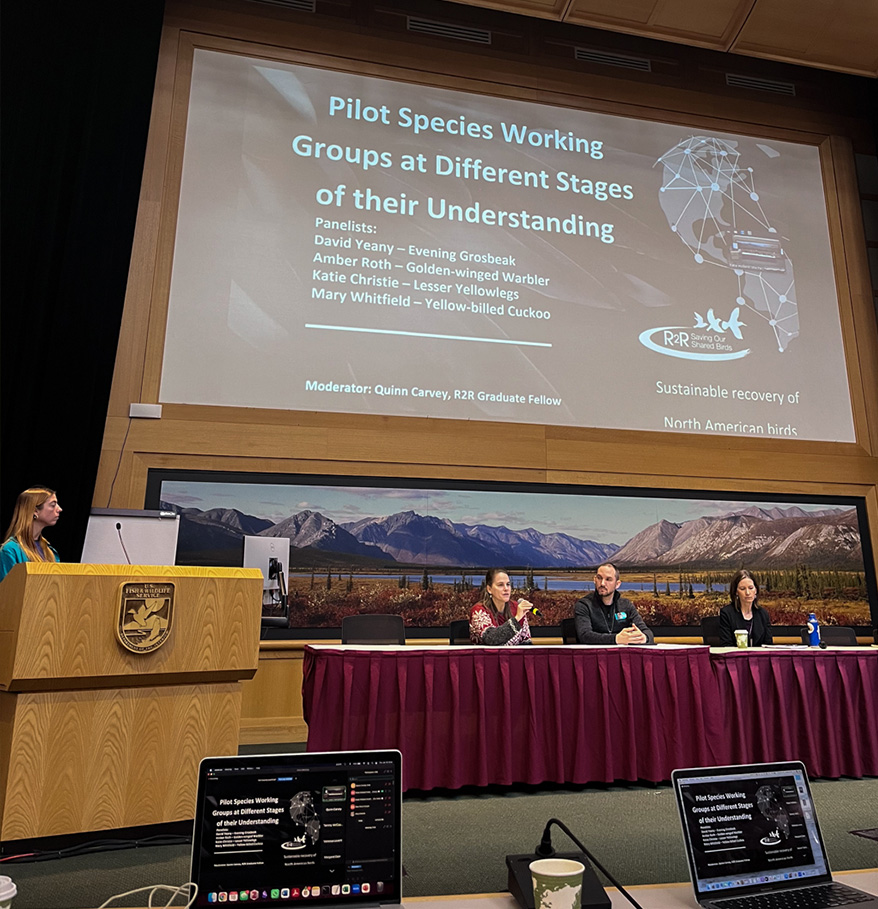

Currently, the R2R team includes Paul Schmidt (Executive Director), Katie Holland (Social Scientist), Kat Temple (Graduate Fellow), and me, Esmeralda Bravo (International Fellow). This core team is guided and supported by an advisory board and an international committee composed of professionals from across the Americas and the Caribbean, including Argentina, Brazil, Colombia, Mexico, Panama, Puerto Rico, The Bahamas, and the United States, who bring experience, strategic vision, and regional commitment.
Although the initial diagnosis focused on the U.S. and Canada, birds remind us that protecting them requires looking beyond borders and considering their entire life cycle—from breeding grounds to stopover and nonbreeding habitats. At R2R, we believe that the principles of this approach are applicable to any declining species, and that strengthening alliances across the Americas and the Caribbean is not only strategic, but essential for achieving species recovery.


Support for Species Working Groups
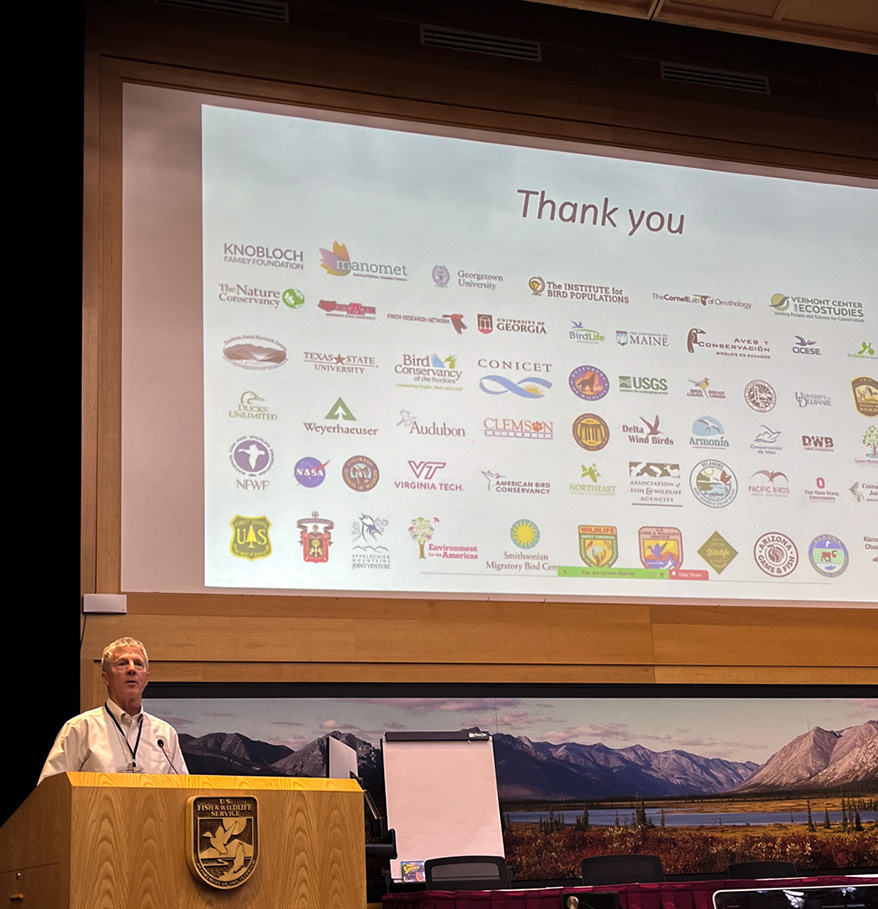
At R2R, we start with the understanding that there are species that require immediate attention—what we refer to as Tipping Point Species. These are species whose recovery depends on urgent action, multidisciplinary collaboration, and evidence-based decision-making. Currently, 35 of these species have an active working group.
Our goal is to strengthen these groups by providing technical tools, training opportunities, strategic support, and greater visibility. We organize workshops, in-person meetings, and virtual seminars to promote technical knowledge-sharing, encourage interdisciplinary collaboration, and drive tangible solutions.
Among our available tools is the Species Recovery Wheel, a self-assessment guide designed to help working groups track their progress toward species recovery. The Wheel integrates biological, social, and co-production criteria across six key action areas. It helps teams visualize progress, identify opportunities for improvement, and support funding applications with concrete evidence.
We also host monthly Species Working Group Webinars—public virtual spaces where teams present their progress, share challenges, and build support networks. These bilingual webinars offer simultaneous English-Spanish interpretation and have played a key role in highlighting collaborative work across the region. In one of these webinars, we welcomed the Coastal Solutions Program and featured two of their fellows, Andreina Pernía and Víctor Ayala Pérez, 2021 and 2022 Coastal Solutions Fellows respectively, who shared their coastal ecosystem conservation projects and their experiences in species recovery. The recorded webinar, available in both English and Spanish, can be found on the Road to Recovery website. Access the full archive of past webinars here.
Biological and Social Sciences together for Conservation
One of R2R’s core principles is its commitment to integrating social and biological sciences—not as an accessory, but as a vital part of the recovery process. Conservation happens in real-world contexts, with real people, which is why we promote the use of community engagement methods, local ecological knowledge, strategic communication, and human well-being approaches.
Our workshops have been a key component of this process. Since 2020, we’ve hosted dozens of virtual—and more recently, in-person—sessions covering topics such as migratory connectivity, demographic analysis, international collaboration, and the role of human dimensions. All of these sessions are open to the public and available on our website.
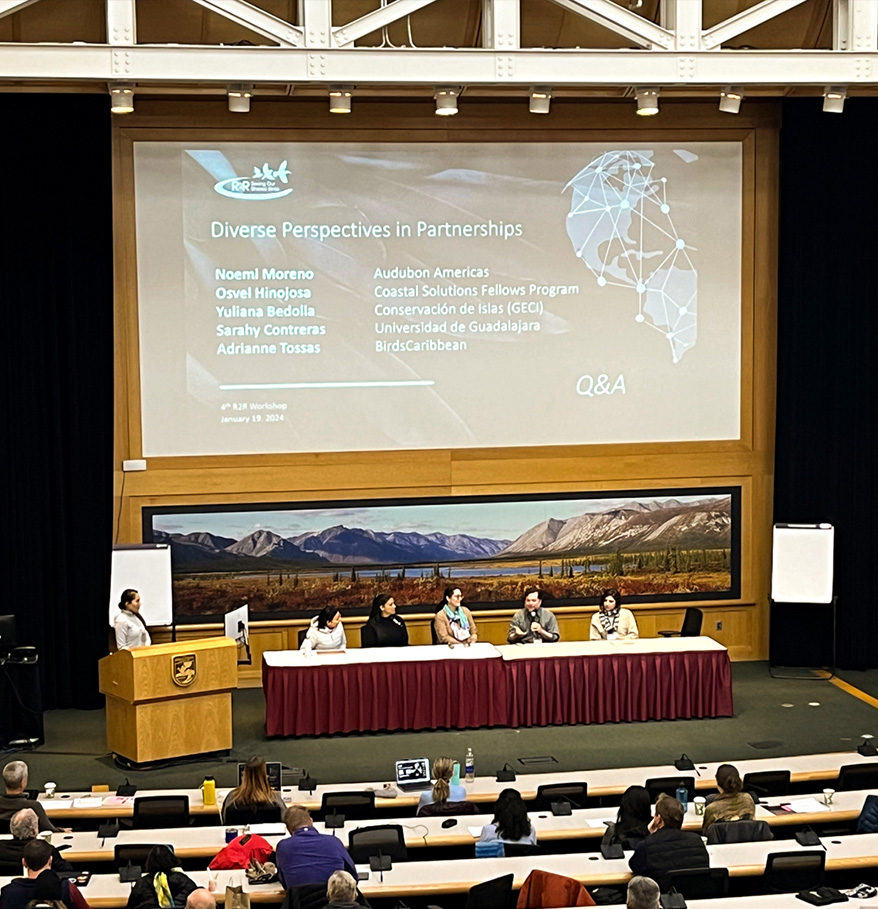
In January 2024, we held our first in-person workshop in West Virginia, where more than 150 participants from 63 organizations across the continent came together to share experiences, tools, and strategies for moving forward. Among them, the Coastal Solutions Program participated through their director Osvel Hinojosa-Huerta, who participated as a panelist in a session on international collaboration; Eliana Montenegro, 2021 Coastal Solutions Fellows and representative of Aves y Conservación , Ecuador, who co-facilitated a session on best practices in transnational partnerships; and Natalia Martínez Curci, 2019 Coastal Solutions Fellow and associated researcher with CONICET, Argentina, as a member of the international working group for the Lesser Yellowlegs and current member of R2R’s international committee.
Building Resilience in Species Recovery
During the January 2024 workshop, it was especially meaningful and inspiring to engage with a large number of young conservation professionals who, over the course of the event, shared their emotional experiences in facing ecological loss and the challenges of conservation work. These conversations clarified for us that bird recovery is not just a technical issue—it is also a matter of collective care, justice, ecological memory, and community healing. This is what led us to imagine a new space within the initiative: Future Leaders in Conservation.
From the very beginning, the Coastal Solutions Program has been involved in shaping this vision—particularly through the input of Osvel Hinojosa-Huerta, who contributed valuable insights on what a support network for young conservationists could look like.
This initiative aims to create a space for young—and not so young—professionals to reflect together on the emotional dimensions of conservation work, exchange knowledge, and build support networks centered around ecological grief. We will soon be sharing more on how to get involved, but for now, we extend a warm invitation to imagine a community that uplifts, connects, and cares.
Collaborative Networks for Effective Conservation
Road to Recovery is not an organization with formal offices or fixed borders. It’s a living movement, brought to life through each working group formed, each new partnership forged, and each effort to turn scientific knowledge into action.
We believe that sustainable solutions require cross-sector collaboration, knowledge exchange, and evidence-based decisions. If you’re part of a coastal organization, working with local communities, or building local solutions to global biodiversity loss, we want to connect with you. On a continent shaped by migratory routes, we know that only by working in collaborative networks can we protect our birds throughout every stage of their life cycle.
You can explore resources and upcoming events at https://r2rbirds.org or contact us at r2rbirds@gmail.com.
The Coastal Solutions Fellows Program builds and supports an international community to design and implement solutions that address coastal challenges across Latin America. Our main goal is to conserve coastal habitats and shorebird populations by building the knowledge, resources, and skills of Latin American professionals, and by fostering collaborations among multiple disciplines and sectors.