
The road to conserving the coastal wetlands of Ica, Peru
By: Darwin García (CSF 2023)
With more than 170 bird species, the coastal wetlands of Pisco and Chincha host about 55% of the total known bird species for the department of Ica, on the south-central coast of Peru. These wetlands are scattered along a 50 km stretch of coastline and together with the Paracas National Reserve Ramsar site, are the second most important site for shorebirds in Peru (with more than 56,000 individuals), after the Tumbes Bay and Mangroves on the north coast.
These ecosystems are home to many shorebird species and other birds that migrate from the northern hemisphere, southern South America, and from the Andean region. Among the most abundant birds are the very small sandpipers of the genus Calidris, including Sanderling (C. alba), Western Sandpiper (C. mauri) and Semipalmated Sandpiper (C. pusilla); plovers such as Semipalmated Plover (C. semipalmatus), Killdeer(C. vociferus), Black-bellied Plover (Pluvialis squatarola),and American Golden-Plover(P. dominica); birds very recognizable by their unique beaks like the American Oystercatcher (Haematopus palliatus) and the Whimbrel (Numenius phaeopus); and others striking for their long yellow legs like Lesser and Greater Yellowlegs (Tringa flavipes and T. melanoleuca).


Wetlands are also home to a rich variety of plants, invertebrates, mammals, fish, and reptiles, many of which are poorly documented. All these species develop their life cycles in these ecosystems, including migratory shorebirds that use these sites for feeding and resting, and some resident shorebirds that use them for breeding, such as the Peruvian Thick-knee, locally known as the “Huerequeque” (Hesperoburhinus superciliaris), Black-necked Stilts (Himantopus mexicanus), Killdeer, and American Oystercatchers.


Developing knowledge and skills for conservation
The professional development component of my Coastal Solutions project “Conservation and governance in the coastal wetland system of Pisco and Chincha” allowed me to visit the UK in September and October 2023. In the company of my mentor, Oliver Q. Whaley, we toured different sites, projects, and organizations, and exchanged experiences with conservationists and researchers on wetland conservation and management.
The first stop was Chichester Harbour in West Sussex, where Peter Hughes introduced us to the Chichester Harbour Conservancy (CHC), an organization working to conserve one of the world’s most important sites for waterbirds. Chichester Harbour is a 18,000-acre coastal landscape of tidal channels and inlets interspersed with mudflats, and is one of the largest marinas in the UK with over 1 million people visiting per year.

One of CHC’s most important activities is the monitoring of bird populations. It contributes data to the monitoring program (Wetland Bird Survey – WeBS) established by the British Trust for Ornithology, which has been collecting monthly data since 1947. This incredible work is only possible thanks to the support of many local volunteers who help gather information that allows for the analysis of trends in bird populations to guide better decision making for conservation.
For example, following the publication of a Wetland Bird Survey report in 2021 that concluded that the nesting population of three species of terns had declined, a project was launched to restore breeding sites for the Common Tern (Sterna hirundo) and the Little Tern (Sternula albifrons). The project built artificial gravel rafts (platforms) and added gravel to natural islands to elevate them and prevent them from being washed away by the tide. They also employed innovative methods such as the use of 3D printed models of the terns to attract mates.
The various human activities that take place in this area exert pressures on birds and their habitats, and sea level rise reduces resting and nesting sites during high tide. To address these pressures CHC is developing marsh restoration projects using dredged sediments, combining novel engineering solutions. In addition, CHC is devoted to educating the public about the impacts human actions can have, encouraging people to keep their dogs away from feeding or resting birds, and to remain on official trails. Finally, through its educational center, CHC offers year-round learning experiences in the natural environment for children as young as two years old.
Our next site visits were to the Wildfowl and Wetlands Trust’s (WWT) Arundel and London Wetland Centers, and to The Royal Society for the Protection of Birds’ (RSPB) Pulborough Brooks Nature Reserve. Arundel Wetland Center is in West Sussex, while the London Wetland Center is in inner-city London. In both cases, the centers are designed for visitors of all ages and abilities. Their trails traverse a variety of habitats including water bodies and offer interpretative signs and shelters for nature observation and photography. Most of the infrastructure is made of natural materials, and the trails are well marked with accessible and detailed information about the birds most likely to be seen at each viewing location and during different months of the year.
The Pulborough Brooks Nature Reserve is an outstanding example of shorebird and waterfowl habitat management and restoration. On its 400 acres, a combination of controlled flooding, grazing, and haying are used to manage grasslands and create habitats for birds. They also are gradually replacing conifer plantations with natural heathlands.


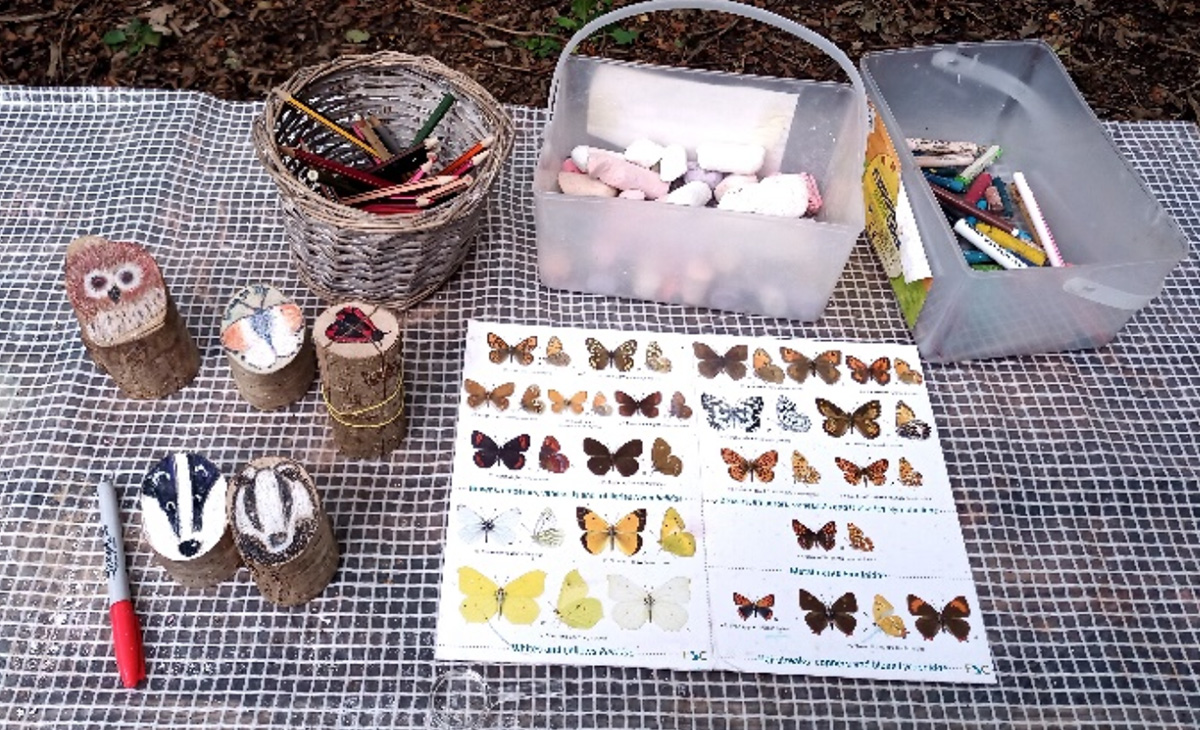
One of the most inspiring experiences of the trip was participating in two ‘Forest School’ trainings taught by Paulina Hechenleitner, at the Holy Trinity Church of England Primary School. ‘Forest School’ methodology, born in the 1950’s in Scandinavian countries, focuses on the integral development of the child, building the long term social and emotional skills through direct experiences in and with nature. In this process, outdoor play, exploration, and supported risk-taking are encouraged.
The natural elements of the environment are the educational materials (wood, leaves, flowers, seeds, recycled elements, etc.), often encouraging children to build their own toys. The use of simple guides of plants and animals helps in exploration, for example, capturing insects to observe and later release them, and the direct observation of plants to recognize them. Art is also encouraged, such as drawing or painting, and skills such as cutting or carving wood, tying knots in ropes, building dens, or lighting fires are taught.
From my point of view, there are three important elements in these sessions: i) at the beginning there must be a catalytic element that fosters trust, in this case the use of soft toys at the beginning of each session relaxes and predisposes the children to be more receptive; ii) the participation of volunteers, whether parents or grandparents and teachers themselves, who together with the leader play a secondary role, first making available all the necessary materials and then becoming spectators providing support when required, and ensuring health and safety; and iii) a common space to share food and feedback, ideally in a circle where at the beginning and end of the session everyone gathers, first to agree on the rules of the session and at the end to share their gratitude and reflections.

Education in and for nature
Back to my Coastal Solutions project site in Ica, there were many ideas to incorporate and implement. We decided to start with education—an essential element to any conservation strategy. During 2023, we had held our first workshops and learned valuable lessons at the José De La Torre Ugarte School in Pisco (JDTU). The method of the workshops was more lecture-based. Even when we incorporated some artistic elements and visits to the wetlands, the lack of a common thread between the sessions was evident. Thus in 2024, after my ‘Forest School’ training, we worked on a new education plan that would incorporate the main elements of ‘Forest School’ philosophy, could be sequential and progressive, but above all, could be adapted to the socioeconomic context of the public schools in Ica.
With Paulina’s recommendations, the hard work of my colleague and friend Luis Casma, and after an extensive review of guides and materials from the Cornell Lab of Ornithology, the Western Hemisphere Shorebird Reserve Network, and the US Fish and Wildlife Service, we developed a plan for primary education (ages 6-12) that consists of five sessions over the course of the year. At the same time, this plan guides the various public education activities, that are also carried out within the framework of the project.
We also decided to broaden our scope, so the JDTU school was joined by the Nuestra Señora de Guadalupe Educational Institution in Pisco (NSG) and Miguel Grau Seminary in Chincha (MGS), to a total of 140 students, and with the involvement of the school principals and teachers in the workshops, in addition to the volunteer support of local professionals linked to wetland conservation.
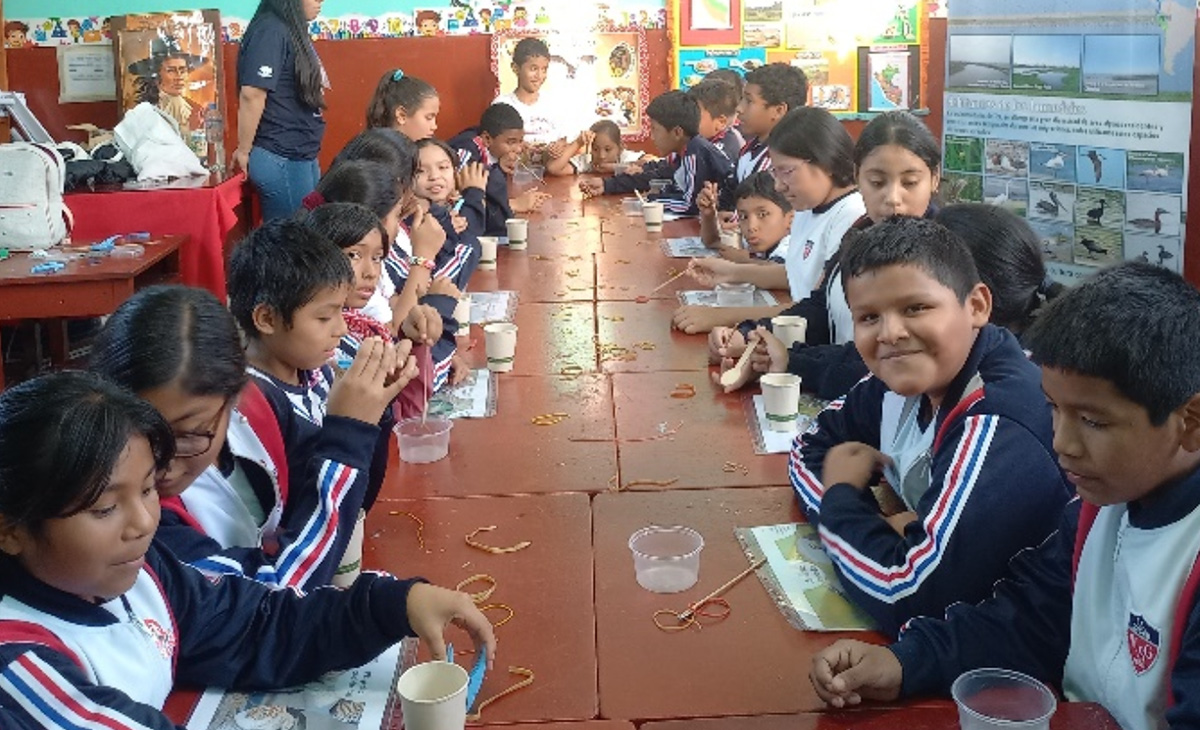
Under our education plan, the learning adventure begins by adapting a “traditional” classroom to instead make one that allows for greater movement and participation of the 20-25 children in each session. We begin with a friendly atmosphere, using the plush stuffed animal toys (gifts from Oliver and Paulina that we have been increasing with donations), and with a brief introduction on the educational workshop. We then invite every student to share about an animal or something that they like.
Throughout the sessions, the students learn to recognize the characteristics of a shorebird, the habitats where they are found, the adaptations they have—such as the different types of beaks for the diversity of food they consume, the enormous journeys they can make during migration, and the challenges birds face on these trips. They also learn to identify some representative bird species and take part in a field visit to the wetlands and beaches, where they observe the birds directly, accompanied by their parents and teachers.

This whole process is conducted through games and group dynamics, such as the game “ponle la pluma al playerito” (“put the feather on the little shorebird”) through which the characteristics of shorebirds are recognized. Or the migration game, where children play the role of birds facing different challenges, and in which they can recognize the importance and impact of improving or degrading their habitats.
Art plays a central role in the sessions, encouraging the children to express themselves through drawings, plasticine (clay) sculptures, bird masks, or wooden medallions. The only rule is that they must depict something that they like or that makes them feel good; it can be their favorite bird, another animal, a plant, or even a special person. All their artistic creations are at the same time theirs to take home.
The 2024 sessions have left us with some lessons. For example, there is a marked difference in the level of learning about environmental issues among schools (even though all the children are of similar ages). This is because schools like JDTU are the focus of many environmental education and conservation initiatives compared to others. So, a next step is to increase the opportunities for more schools to access these types of workshops. We have found that the most suitable and sustainable approach is to provide capacity building for teachers in the various schools, all under the patronage and endorsement of the local education authorities. This is something we will continue working on.
A common denominator among schools is the lack of natural spaces to develop educational activities outside the classroom, and therefore it is important to help improve their facilities with native plants in the schools with available areas. For example, at the MGS school we are working to improve the school vegetable gardens and to expand the remnants of native vegetation that they have on the premises. This is a long-term effort, but it will eventually allow us to have open-air classrooms and a source of natural materials for all kinds of uses in education.
Finally, in 2025 we plan to continue with the workshops in the same schools, and we are looking for new materials for future sessions. Although in principle the focus of the sessions is on shorebirds, this is a good opportunity to connect with biodiversity in general and incorporate elements such as seeds, fruits, and flowers, to enrich the children’s experience and foster their connection with nature from an early age.


The Coastal Solutions Fellows Program builds and supports an international community to design and implement solutions that address coastal challenges across the Pacific Americas Flyway. Our main goal is to conserve coastal habitats and shorebird populations by building the knowledge, resources, and skills of Latin American professionals, and by fostering collaborations among multiple disciplines and sectors.